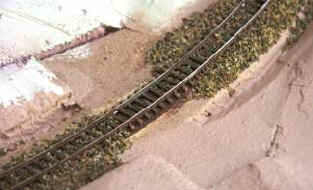
I
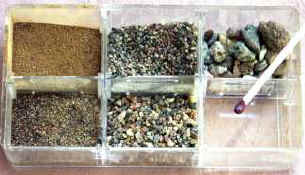
normally use sand in different grains for ballasting.
To get the different grains I use strainers and even
nylon stockings for the finest grain.
The
different grains have different colours depending on
their origin. |
 |
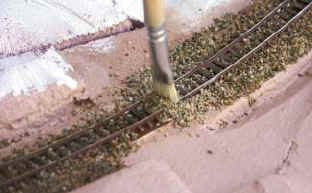
The sand is spread out, covering the sleepers and a
5-10 millimeters on the outside.
With a brush the sand is leveled leaving the sleepers visiable.
The sand is
moistened with a dropper and water with a little softener.
This will make it more easy for the diluted PVA glue to cover
the hole area.
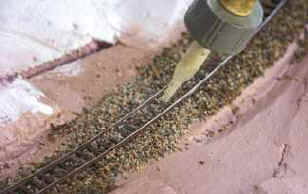 |
Then the diluted PVA-glue is applied wwith the same
dropper, enough glue to cover all the sand.
The dropper should be rinsed with water to stay clean
whenever you will take a breake.
This takes quite a time and you have to be patient and
careful, especially on the wide station areas.
The white PVA glue is diluted with water 50/50 and a few
drops of softener. |
When the glue is
nearly dry it is time to get the sleepers and rails clear of the
sand that has stuck there by mistake.
Embankments:
|
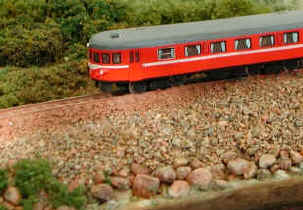 |
Here you will have to use the more coarse grains to
model stones..
|
Färg:
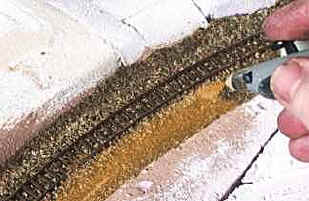
When the sand is completely dry the colour has become darker
compared to the original colour of the grain.
Sometimes it looks right, but mostly you will have paint the
sand to get the right tone.
 |
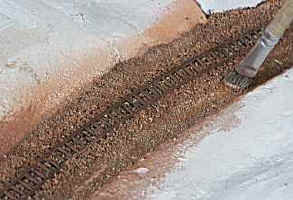 |
A
light spray with
an airbrush to get the red/brown colour of ballast made
of stones from the iron ore area.
|
A
light drybrush with white colour gives the ballast a
more natural look. |
-
- - -
upp
 Back
Back